
You’ve already looked up the institution. You’ve checked whether the instructor has a LinkedIn you can verify. And you’re now trying to decide whether a programme from a brand you don’t yet recognise is worth choosing over the well-established names you can already see from here.
That instinct is the right one. This article is designed to help you apply it properly.
Is it worth investing in AI skills as a professional in Singapore right now?
Resident tech workers in Singapore earned a median monthly wage of S$7,950 in 2024, compared to the overall resident median of S$4,860. That’s a meaningful premium for a skills set that’s still in its growth phase. AI-specific roles are still a growing minority of tech postings in Singapore, not yet saturated, which means the window for differentiation is still open.
The market case for investing in AI skills is clear and you probably already knew it before reading this. The question for a working professional in Singapore isn’t whether the skill is worth having. It’s whether this specific programme earns the investment over the structured alternatives you can already access.
AI training worth paying for in Singapore as a working professional is training that produces a signal employers here can read. What that looks like in practice is the rest of this article.
Why doesn’t a generic AI certificate differentiate you in Singapore’s market?
Most analytical professionals in Singapore have already accumulated recognisable certificates. Adding another one from a well-known global platform produces another line on a CV, not a signal that stands out in a market where your peers have largely done the same thing.
Here’s what’s actually happening:
- Most candidates at your level already hold the same widely available certificates from the same well-known platforms
- Generic curricula are designed for a global audience. They are not built around the business contexts you will encounter in Singapore and SEA
- Self-paced completions produce no peer network, no instructor relationship, and no verifiable project output that an employer can look at independently
Most Singapore professionals now work in organisations that have introduced AI tools in some form. That exposure is not the differentiator. Demonstrated, applied capability is, and it shows through what you built, not what you completed.
What should working professionals look for in a paid AI programme in Singapore?
Before committing to any programme, these are the things worth verifying:
- A concrete portfolio deliverable: does the programme end with something you built, or a certificate you completed?
- Practitioner instruction: does the instructor have a LinkedIn with production AI experience in fields relevant to Singapore’s market?
- A cohort of peers at your professional level, not a mixed room where the curriculum has to accommodate every starting point
- A curriculum with SEA-relevant application, not a global template adapted for this market
- A schedule that doesn’t require leaving your current role
Singapore’s SkillsFuture ecosystem sees hundreds of thousands of participants annually, reflecting both the scale of structured training options available and the demand for them in this market. Not all programmes are equivalent, and the checklist above is what separates mid-career AI training in Singapore that’s worth it from programmes that produce another credential for an already-long list.
Does BuildrLabs meet that bar for working professionals in Singapore?
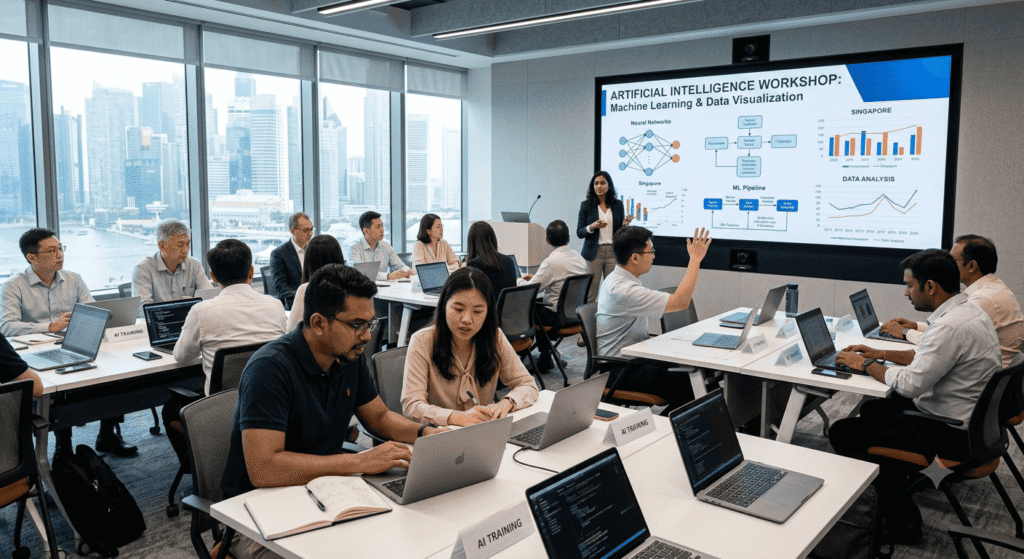
The Agentic AI Bootcamp at BuildrLabs is a project-based, cohort-format programme with practitioner instructors and a SEA-contextualised curriculum. Here’s what it offers against the checklist:
- Portfolio deliverable: you exit with real AI projects built during the programme, not a certificate
- Practitioner instructors: LinkedIn profiles with production AI experience in relevant fields, which you can check before committing
- Cohort structure: fixed schedule, peers at your professional level, external accountability built into the format
- SEA-contextualised curriculum: designed around the kinds of problems and business contexts relevant to Singapore and the broader region
BuildrLabs is a newer brand in Singapore. That’s worth naming directly rather than working around. What to evaluate isn’t the brand history but the specifics: the instructor’s LinkedIn, what exactly gets built each week, and whether the programme output is something a Singapore employer would find legible and relevant. AI skills for professionals in this market are worth paying for when those specifics check out.
Is paying for AI training worth it for working professionals in Singapore?
If you’ve been asking whether AI training is worth paying for in Singapore, you now have the framework to answer it for your situation. The value isn’t in the name on the certificate. It’s in the project output, the practitioner instruction, the peer cohort, and the SEA-relevant curriculum.
Mid-career AI training in Singapore that produces a concrete portfolio is a different investment from training that produces another credential.
If BuildrLabs meets the bar you’ve set, apply for the next cohort.
Frequently asked questions about AI training for professionals in Singapore
How do I verify that the instructors actually have relevant experience?
Check their LinkedIn profiles directly before committing. Practitioners teaching from active industry experience will have verifiable histories in relevant roles and projects. Ask specifically what they’ve built or shipped professionally, not just what they teach, and assess whether that experience is relevant to Singapore’s market.
Is this programme SkillsFuture-eligible?
BuildrLabs is not currently SkillsFuture-registered. If SkillsFuture eligibility is a requirement for you, that’s a real constraint to factor in. The programme’s value is in the project output and cohort structure. Whether that matters more than subsidy eligibility is a decision only you can make.
How is a cohort programme different from a self-paced AI course?
A cohort has a fixed schedule, peers at your level, instructor feedback, and a project deliverable at the end. A self-paced course has none of those things. In Singapore’s market, where most candidates already hold self-paced certificates, the cohort portfolio is a meaningfully different signal in an application.
I’m already using AI tools at work. Is this too basic for me?
Using AI tools occasionally is different from building AI-assisted workflows mapped to your professional function. The programme is for professionals who want to move from ad hoc use to systematic application, with a portfolio of built projects as the output. Whether that gap exists for you is worth confirming on a call with the BuildrLabs team.
What happens if I miss a Saturday session?
This is worth asking the BuildrLabs team directly during the screening call. A cohort with a fixed schedule is built around consistent attendance, and understanding the expectations before you enrol is the right step.

